
Raenest is one of the best ways for a freelancer or remote worker in Africa or Asia to get paid in dollars, euros, or pounds, and convert, save, invest, or spend that money. It’s important to understand Raenest's different features and fee tiers and, most importantly, whether the fintech product is ideal for your use case. Raenest is strongest for freelancers, remote workers, Upwork earners, people who want USD, GBP, EUR, and stablecoins in one app, and anyone who wants savings or US stocks next to their earnings.
Raenest (formerly Geegpay) is a cross-border payments app founded in Nigeria in 2022 that gives freelancers, remote workers, and businesses USD, GBP, and EUR receiving accounts, USDC and USDT wallets, a Visa card, local-currency payouts, US stock investing, and savings vaults.
The fintech product app experienced massive growth in 2026 following its latest funding round in 2025: deposit fees changed on October 6, a Stablecoin Vault paying up to 7% variable APY launched in September, a physical Visa card arrived on October 19, and they announced fixed-rate NGN and USD Locked Vaults at the Raenest Exchange event on October 21.
Below, I break down every feature, fee, with worked examples, what real users report, and exactly who should (and shouldn't) use Raenest.
Raenest Review: Key Takeaways
- Verdict: I recommend Raenest for freelancers, remote workers, and businesses that get paid in USD, GBP, EUR, or stablecoins, especially via Upwork.
- Receiving USD by ACH costs $2 under $500 and $4 from $500 (since October 6, 2026). Wires cost $10 flat, so ACH is cheaper at every size.
- The Visa card has no funding fee, but every purchase costs $0.70, plus 2% + $0.40 on non-US websites. That benefits you on big money subscriptions but hurts on small subscriptions.
- Newest launches: Stablecoin Vault (up to 7% variable APY, $100 minimum), physical Visa card, and NGN/USD Locked Vaults with fixed rates. All were announced at Raenest Exchange 2026.
- Raenest might not be for you if reverification, authentication, and delay on a large payment would hurt you.
How I tested Raenest
I’ve been using Raenest (formerly Geegpay) since mid-2023, so I’ve had a front-row seat to how the product has evolved over the years.
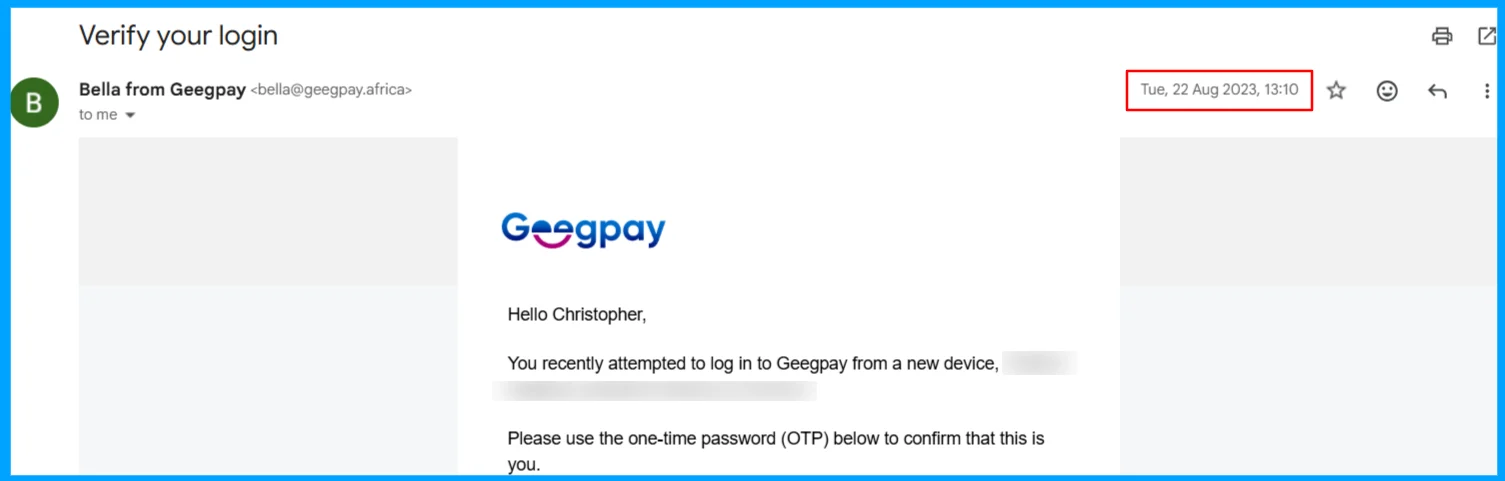
I started using Raenest because I was frustrated with the high fees I was paying to receive payments from clients and platforms like Upwork and Fiverr through Payoneer. While searching for a more freelancer-friendly Payoneer alternative for receiving international payments, a friend recommended Raenest. Since PayPal wasn’t an option for receiving money in my country, Raenest also became a practical PayPal alternative for me.
Since then, I’ve used my Raenest account to receive, save, invest, and spend money across USD, EUR, GBP, and my local currency. I’ve also recommended the platform to colleagues looking for a reliable way to receive payments from international clients and employers.
For this review, I went beyond my personal experience to explore and test as many of Raenest’s features as possible. I also interviewed colleagues who use the platform and reviewed its help-center documentation, monthly product roundups, App Store listings, Trustpilot reviews, independent news coverage of its funding rounds and product launches, founder interviews, and other relevant sources. You’ll find the full list of sources at the end of this review.
What is Raenest?
Raenest is a fintech app for people who earn in foreign currencies but live in emerging markets. It started in 2022 as an employer-of-record service helping foreign companies pay African staff, then shifted toward individuals and businesses who needed foreign bank details of their own, according to TechCrunch's coverage of its Series A (opens in a new tab). Its consumer app was called Geegpay until the products were merged under the Raenest name.
Fact | Detail |
|---|---|
Founded | 2022, by Victor Alade (CEO), Sodruldeen Mustapha (CTO), and Richard Oyome (COO) |
Funding | $14.3M in total, including an $11M Series A led by QED Investors (February 2025) |
Users | Over 1,000,000 people and 11,000+ businesses (October 2026) |
Volume | More than $2 billion moved for users. |
Where Raenest works | Receive from 190+ countries; cards and local payouts in Nigeria, Ghana, Kenya, Uganda, Egypt, South Africa, Rwanda, and the Philippines; launched in India and the Philippines in February 2026. Current continuous expansion into new countries. |
Currencies | USD, GBP, and EUR accounts; USDC and USDT wallets; local currencies in supported countries. |
Raenest’s pitch is simple: The app gives you a foreign account number that your clients, employers, and platforms can pay into; then you can keep, spend, invest, or convert the money with or without a traditional bank in the middle.
Key features and how well they work
USD, GBP, and EUR accounts
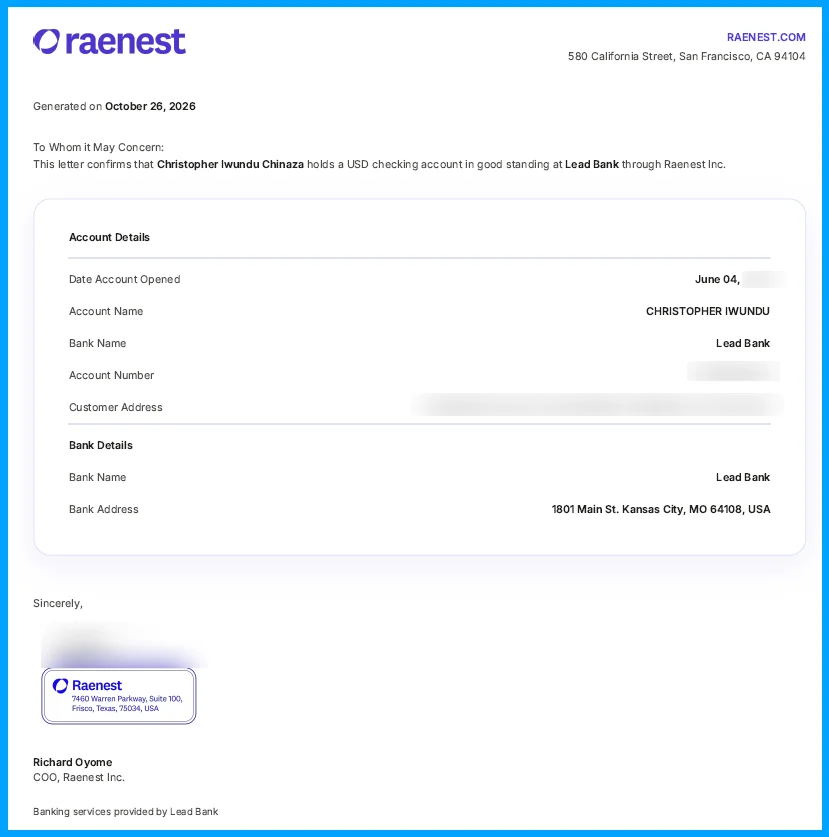
Raenest helps you create and own foreign account details that clients, employers, and platforms can pay directly into. Payments from verified platforms such as Upwork, Fiverr, Deel, Gusto, Payoneer, Wise, Mercury, Brex and Amazon KDP are supported.
This has been a game-changer for freelancers and remote workers in developing countries, where receiving international payments can be a real struggle. PayPal doesn’t support receiving money in many of these markets, while other available options often eat into your earnings through fees and unfavourable exchange rates.
Raenest helps bridge that gap by giving you USD, GBP, and EUR receiving accounts, so you can get paid by international clients and employers in major currencies without relying solely on traditional payment platforms. Instead of just receiving your money, you can also convert, transfer locally, save, invest, or spend the money through the same app. For freelancers who want more control over how they receive and manage their hard-earned money, having these options in one place makes a real difference.
Creating a USD, GBP, or EUR account on Raenest takes about 3 minutes. Get your documents ready before you start the process.
Typically, you'd need to upload one of the following clear, readable documents:
- A bank statement
- Your Raenest statement
- A signed contract
- An Upwork statement of earnings
- Another valid proof of income or earnings.
- If you select that the account is for receiving remote work or business payments, you will also need a link to your work profile, such as Upwork, Fiverr, or LinkedIn.
These USD account opening verification documents are different from the general Raenest profile verification documents that you upload for initial account setup.
Your general Raenest account opening requires:
- A valid government-issued ID: international passport, national ID card, or driver's license
- Proof of address: a recent utility bill or official document showing your home address
- Phone number & email address for OTP and security verification.
Note: Since May 2026, new USD accounts run on a new banking partner with faster ACH, FedNow support, and improved domestic wires, and opening an account requires proof of earnings (a bank statement, a Raenest statement, or another proof of income). If you signed up before May, create a new USD account and update the USD details you've given to Upwork, Fiverr, and your clients. If you’re a new user, your account is automatically the newer, faster version.
FastTrack for Upwork
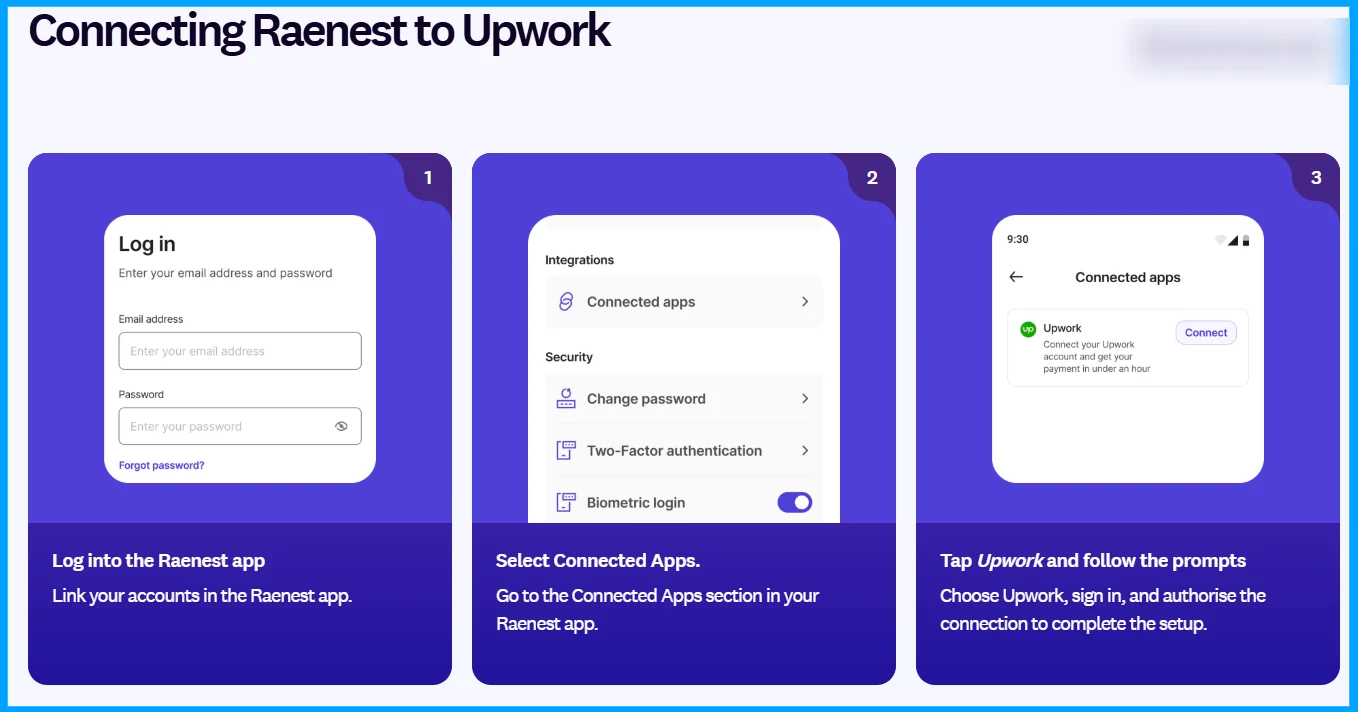
FastTrack is Raenest's strongest feature for freelancers on Upwork. Connect your Upwork account in the app, and withdrawals to your Raenest account arrive in under an hour, including on weekends, up to $1,500 on weekdays and $500 on weekends. Larger withdrawals make you go through the reverification process, typically taking about 24 hours.
Raenest's CEO, Victor Alade, called it (opens in a new tab) the first offering of its kind:
"We're proud to be the first fintech company to offer this level of speed and reliability to the freelance community"
If you have a withdrawal to make from Upwork, I recommend you budget for the full cost. Since September 1, 2026, Upwork charges freelancers with a non-US tax address $2.99 per "Direct to U.S. Bank" withdrawal, and Raenest's ACH deposit fee ($2) applies on top. A $400 withdrawal costs $4.99 (1.25%); a $1,000 withdrawal costs $6.99 (0.7%). So, I highly recommend fewer, larger withdrawals if you’re using Raenest for Upwork withdrawals.
Note: If you sign in to Upwork with Google, you'll need to log in with your Upwork email and password to connect FastTrack.
Stablecoin wallets
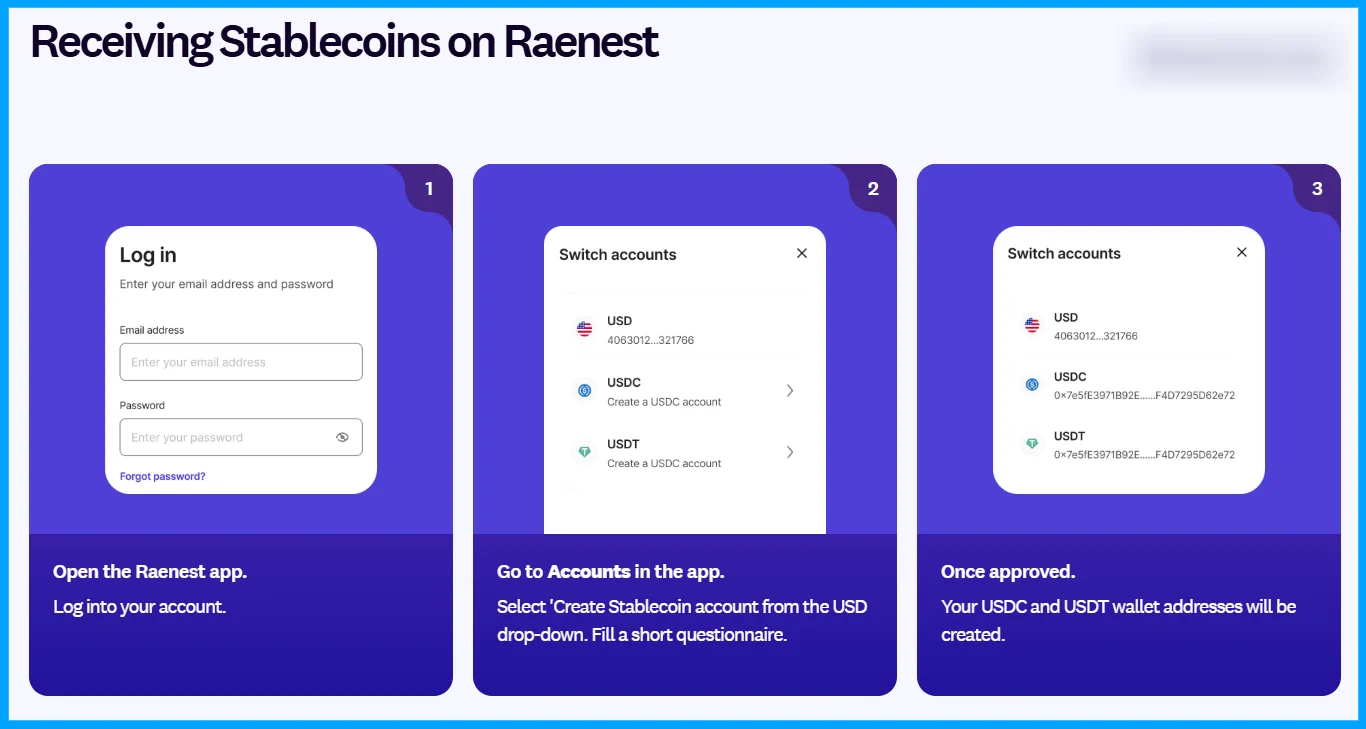
You can receive, hold, and send USDC and USDT in their original form, convert them to fiat, and spend them with the Raenest card. For anyone paid in crypto by international clients, this is cleaner than routing through an exchange.
When Raenest rolled out stablecoin deposits in November 2025, deposits were typically auto-converted to fiat at a 1:1 conversion rate. However, by September 2026, Raenest upgraded its systems to allow you to receive and hold the stablecoins in dedicated wallets.
Note: As of October 2026:
- You can receive and hold USDC with Raenest on Base, Ethereum, Solana, and Polygon networks.
- You can receive and hold USDT with Raenest on Ethereum, Tron, Binance, Solana, and Polygon networks.
Stablecoin Vault
The Stablecoin Vault (launched September 22, 2026) pays a variable yield of up to 7% APY on USDC and USDT, with a $100 minimum, daily compounding, and no lock-up. Earnings start 24 hours after your deposit, according to Raenest's launch post (opens in a new tab).
Because I have some level of experience with how these things work, I dug deeper (opens in a new tab) to uncover the caveats of Raenest stablecoin vaults. Here is what to know before you treat this product like savings:
- The yield comes from decentralized finance (DeFi) protocols, and returns aren't guaranteed.
- There's no deposit insurance. Raenest says the Vault is "not a bank account or a savings account."
- Withdrawals are normally expected within two hours, but may take four business days or longer in exceptional cases such as liquidity shortfalls, network congestion, security incidents, or compliance reviews.
- Stablecoins can lose their dollar peg.
The maths can look like this: $1,000 at the full 7% earns about $70 a year, or roughly $5.80 a month. If you fund your vault from your EUR, GBP, or local currency balance, you’ll be charged a conversion fee; if you fund the vault from your USD, USDT, or USDC balance, you skip the conversion cost entirely.
Locked Vaults
Locked Vaults (NGN and USD, launched in October 2026) are fixed-rate savings pots: lock naira (minimum ₦50,000) or dollars (minimum $100) for 1, 3, 6, 9, or 12 months at a rate set when you’re opening the Vault, per Raenest's help center (opens in a new tab). Interest is simple, not compounded, and paid at maturity. You can fund a Vault from any wallet, but you can't top it up or change the term once it's funded.
Two things to factor in:
- 10% withholding tax is deducted from NGN Vault interest, as the Central Bank of Nigeria requires, and
- Breaking a Vault early forfeits all interest plus a ₦1,000 or $1 fee.
The Raenest Visa card
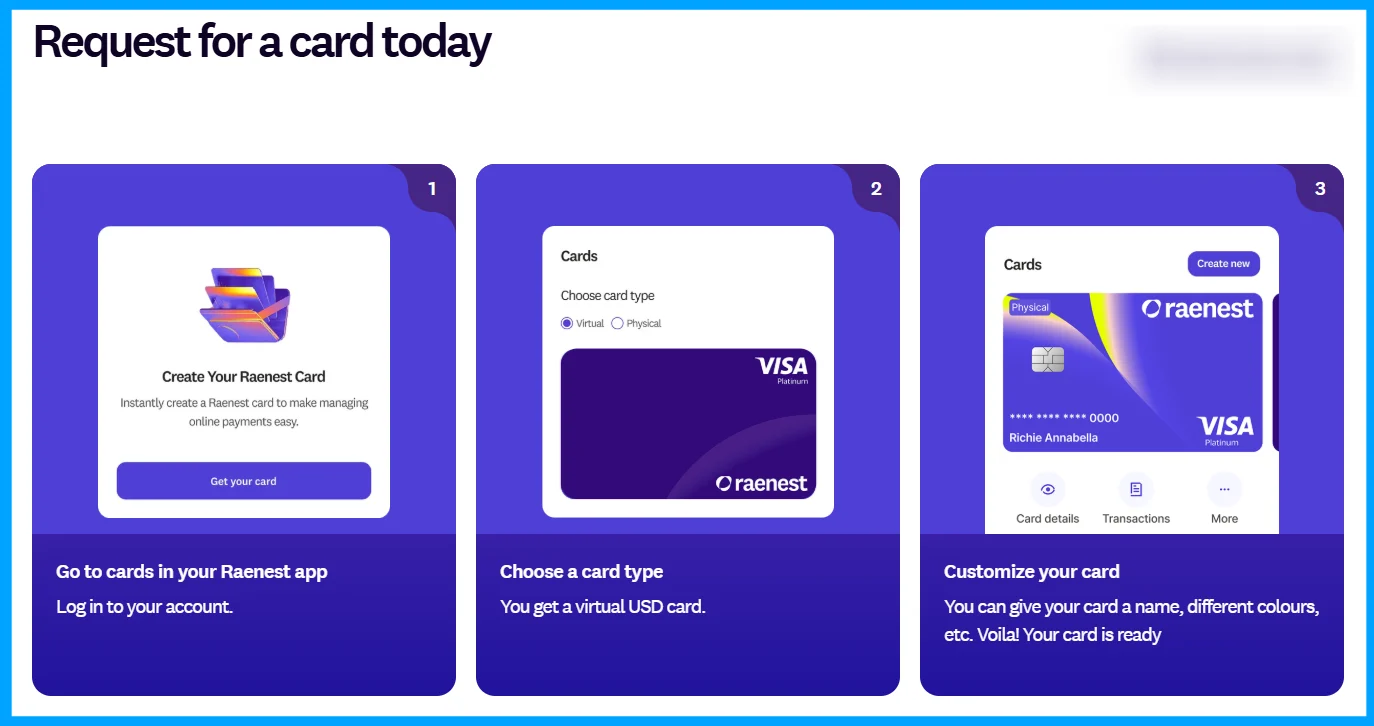
Raenest now offers both a virtual card and a physical card that spend directly from your USD, GBP, EUR, NGN balances, and stablecoins, so there's no separate "fund the card" step. The card works with Apple Pay and Google Pay. The new physical Visa Platinum debit card, launched October 19, 2026, and announced at the Raenest Exchange event, adds in-store and ATM use in Nigeria, Ghana, Kenya, Uganda, Egypt, South Africa, Rwanda and the Philippines, with card delivery within 15 business days.
Before now, you can only own one virtual card at a time. However, Raenest made key card product update announcements at Raenest Exchange.
- Multi-Card Management: You can have up to four active virtual cards concurrently and assign a specific purpose to each one (such as separate cards for subscriptions, ads, travel, or team spending).
- Physical Cards Introduced: Alongside the multi-virtual card update, they introduced the Raenest Physical Card, offering both a Prepaid version (which you fund manually) and a Standard version (which links directly to your main Raenest multi-currency balances).
US stocks and Auto-Invest
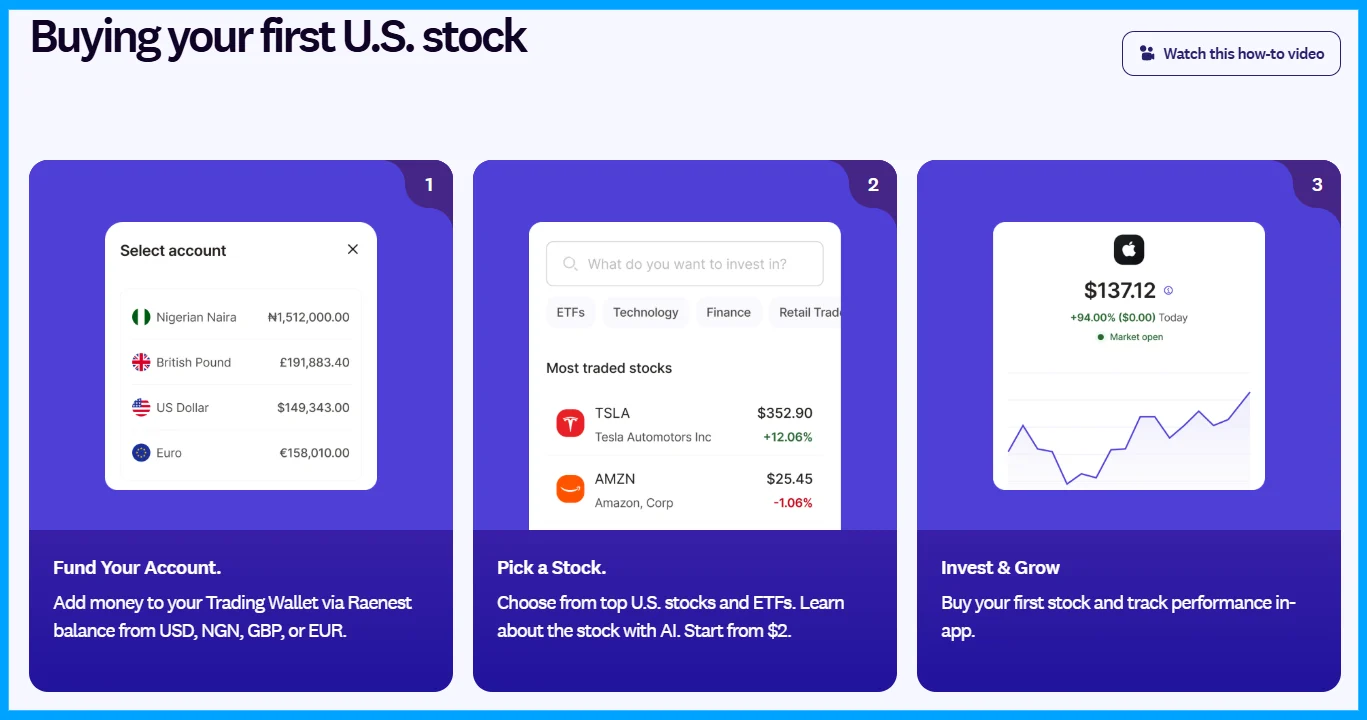
With Raenest, you can buy more than 4,000 US stocks and ETFs from $2. You can use the Auto-Invest feature to buy stocks on a weekly or monthly schedule that you set yourself, and you can edit, pause, resume, or delete your Auto-Invest plan at any time. You fund your trading wallet directly using your NGN, USD, GBP, or EUR balances inside Raenest.
Brokerage is provided by Alpaca Securities (a FINRA and SIPC member) in partnership with City Investment Capital, licensed by Nigeria's SEC.
At fees standing at 0.8% per trade with a $0.75 minimum, several small purchases are expensive in percentage terms in the long run: a $10 buy costs $0.75 (7.5%). My recommendation is that if you must use Auto-Invest, you should use it with larger, less frequent purchases.
Payment links and invoices
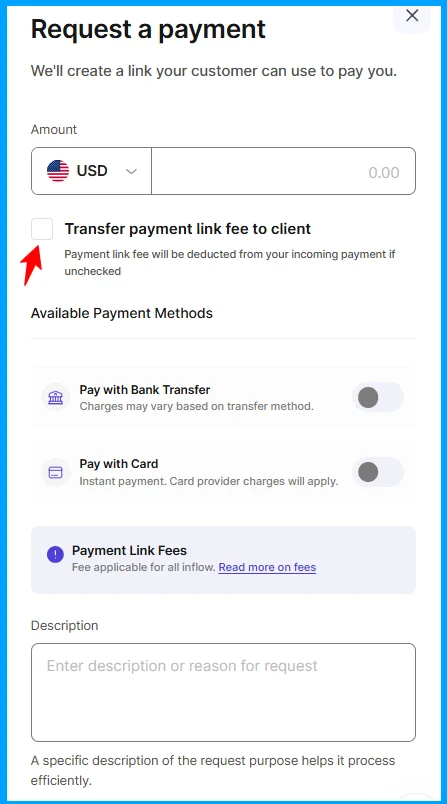
With Raenest, you can create up to five payment links a day to request money from clients without sharing bank details. Creating a link is free; you only pay your normal deposit fee when the money arrives, and you can choose to pass that fee to the client.
Raenest Bills Payments
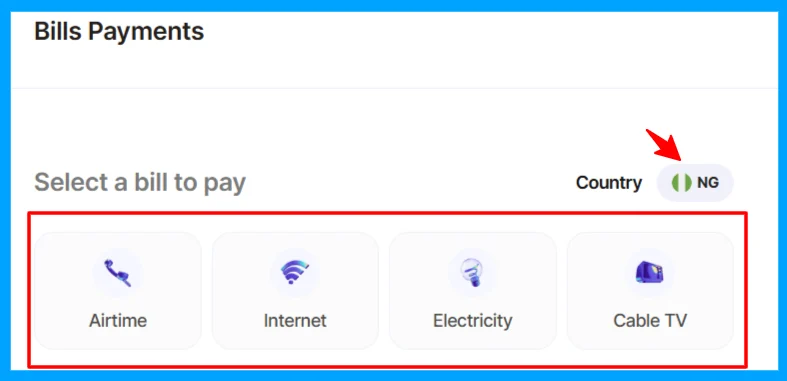
If you’re in Nigeria, you can use Raenest to pay for your everyday utility bills:
- Airtime
- Internet
- Electricity
- Cable TV
This feature is often overlooked, but it comes in handy if you’re in Nigeria and wish to pay for airtime, internet, electricity, or cable TV directly from your Raenest account.
Current Raenest fees (updated): the full breakdown
Raenest charges for receiving money, converting it, and using the card, but sending money to a Nigerian bank account is free. Raenest charges a fixed flat fee for sending money to local accounts in other countries, and the app shows the exact fee before you confirm anything.
If you’re reading this review from outside Nigeria, check (opens in a new tab) Raenest’s extensive pricing for each country (opens in a new tab).
Receiving money fees
How the money arrives | Fee |
|---|---|
USD by ACH, under $500 | $2 flat |
USD by ACH, $500 or more | $4 flat |
USD by domestic wire | $10 flat |
USDC or USDT | $1 flat ($2 on the TRON network) |
EUR bank transfer | 0.8% (minimum €1.50, maximum €10) |
GBP bank transfer | 0.8% (minimum £1.50, maximum £10) |
What this means in practice:
- ACH beats wire at every size. A $5,000 payment costs $4 by ACH and $10 by wire. If a client asks how to pay you, give them the ACH details.
- Small deposits are the expensive ones. $2 on a $100 payment is 2%. $4 on a $2,000 payment is 0.2%. If you invoice the same client weekly for small amounts, ask them to pay monthly instead.
- The $500 line matters. A $499 payment costs $2 (0.4%); a $500 payment costs $4 (0.8%).
- Avoid TRON for stablecoins. The same USDT/USDC costs $1 to receive on other supported networks and $2 on TRON.
- EUR and GBP fees stop growing at €1,250 / £1,250, where the 0.8% hits the €10/£10 cap.
Converting and withdrawing fees
Sending money to a Nigerian bank account costs ₦0. The cost you pay is the conversion from USD to naira.
I checked, Raenest no longer publishes a conversion percentage. In January 2026, it cut the USD-to-NGN fee to 0.5%, with a $0.25 minimum and $2.70 maximum, according to its January roundup (opens in a new tab). Truth is, from my experience using the product, the conversion fees vary depending on the currencies you’re converting between. You see the conversion fee on the conversion screen before you confirm.
Upon testing different conversion amounts, I noticed that conversion fees don’t exceed a maximum conversion fee of $2.70 for USD, £2.01 for GBP, and €2.40 for EUR. I also noticed that USDT and USDC conversions charge a conversion fee of 0.7%.
Card fees
The Raenest card is free to fund and maintain, but it charges for every successful purchase.
Card fee | Virtual card | Physical card |
|---|---|---|
Create or order | $3 one-time | $3 one-time, plus delivery: $15 in Nigeria, $40 elsewhere |
Each successful transaction | $0.70 | $0.70 |
Purchases or refunds on non-US websites | 2% + $0.40 | 2% + $0.40 |
Declined for insufficient balance | $0.40 | $0.40 (after 2 free declines a month) |
ATM withdrawal | Not applicable | $2 + 2% |
Dispute (chargeback) | $50 | Not listed |
Funding, maintenance, monthly fee | Free | Free |
The caveat when using Raenest cards is for small purchases. A $10 subscription from a US company costs $10.70, an effective 7% extra. If the merchant is outside the US, the same $10 costs $11.30 (13% extra). A $100 purchase from a non-US store costs $103.10; the card fee margin thins down as the transaction amount increases. So, I’d recommend it for occasional large purchases, travel, and ad spend. It's an expensive way to pay for five $5 subscriptions a month.
Investing and savings fees
- US stocks: 0.8% commission on every buy and sell, minimum $0.75.
- Stablecoin Vault: Raenest doesn't list a fee for moving USD, USDC, or USDT into the Vault, but converting into USDT/USDC costs 0.7% from other currencies. Raenest's launch post lists a $0.20 withdrawal fee.
- Locked Vaults: no stated fee to open; breaking a Vault early forfeits all interest and costs ₦1,000 (NGN) or $1 (USD).
Raenest limits
Raenest's limits depend on your verification tier; I recommend a higher tier if you receive high amounts of money as a remote worker or freelancer. Here is what you should know about the limits.
Limit | Amount |
|---|---|
Daily incoming payments | $10,000 (tiers 1–4), $20,000 (tier 5), $50,000 (tier 6), $150,000 (tier 7) |
Daily outflow limits (this is different from card spending) | Tier 1 ($1,600), tier 2 ($2,800), tier 3 ($4,000), tier 4 ($8,000), tier 5 ($16,000), tier 6 ($40,000) |
Upwork FastTrack (paid in under an hour) | Up to $1,500 on weekdays, $500 on weekends |
Card spending | Up to $20,000 a day and $60,000 a month, depending on verification level |
Card transactions | 50 a day, 200 a month |
US stocks (daily buys) | $7,000 (tier 1) to $15,000 (tiers 4–5) |
Payment links | 5 a day |
Raenest pros and cons
Raenest: pros and cons
Pros
- Pro: USD, GBP, EUR and stablecoin accounts in one app, with free payouts to Nigerian bank accounts
- Pro: FastTrack gets Upwork withdrawals to you in under an hour, even on weekends (up to $1,500 on weekdays)
- Pro: Flat ACH fees ($2/$4) are cheap on larger payments, and ACH is always cheaper than a $10 wire
- Pro: Card spends straight from your balances, with Apple Pay, Google Pay and now a physical card
- Pro: Earnings, savings (Vaults) and US stocks in the same app
- Pro: Licensed in Nigeria, registered in the US and Canada, backed by well-known investors
Cons
- Con: Fees changed several times in 2026; free monthly deposits ended on October 6
- Con: $0.70 per card transaction, plus 2% + $0.40 on non-US sites, makes small purchases expensive
- Con: Compliance holds and slow support are the top complaints
- Con: Conversion fees are no longer published as a fixed rate
- Con: Stablecoin Vault yield is variable and has no deposit insurance
- Con: USD accounts now require proof of earnings
What's new on Raenest?
Raenest has been busy since its latest funding round and shipped something almost every month in 2026. Here is the timeline I put together from Raenest's monthly roundups, help center, and app-store notes.
When | Launch or change |
|---|---|
January 2026 | US stocks and ETFs from $2; monthly Rewards for keeping $100+ in the USD wallet; conversion fee cut to 0.5% (capped at $2.70) and four free deposits a month |
February 2026 | Launch in India and the Philippines with FastTrack for Upwork; TerraPay partnership for local payouts; send money to Canada in CAD |
March 2026 | Daily inflow limits raised to $10,000–$150,000 depending on verification tier; USDT and USDC on Solana. |
April 2026 | Raenest Perks partner discounts; up to 5% off bills in Nigeria; the card works in Apple Wallet |
May 2026 | New USD accounts on a new banking partner (faster ACH, FedNow, better domestic wires), now requiring proof of earnings; Auto-Invest for recurring stock purchases |
August 2026 | The Raenest Visa card spends directly from your balances: no card funding step, Apple Pay and Google Pay, limits up to $20,000 a day |
September 22, 2026 | Stablecoin Vault: up to 7% variable APY on USDC and USDT; dedicated stablecoin wallets |
October 6, 2026 | New deposit fees: free monthly deposits ended; ACH became $2 under $500 and $4 from $500 |
October 19, 2026 | Physical Visa Platinum debit card for eight countries |
Week of October 21, 2026 (Raenest Exchange week) | App version 3.7.9: fund your account with Bitcoin, plus fixed-rate NGN and USD Locked Vaults. |
From my observation and what I gathered from the Raenest EXchange event, the direction is clear: Raenest wants to be where you keep and spend your money, not just a channel you pass it through. TBH, that's good for convenience, but it also means paying close attention to the fees and assessing your money’s safety.
Is Raenest safe and legit?
Raenest is a legitimate, licensed company, but it is not a bank; experience has taught me that distinction matters for how your money is protected. Raenest is licensed by the Central Bank of Nigeria as an International Money Transfer Operator; its US entity, Raelic LLC, is a registered Money Services Business (NMLS ID 2746973); Raenest Inc. Canada is registered with FINTRAC; and UK services are provided through Clear Junction, an FCA-authorized electronic money institution. It is backed by investors including QED, Norrsken22, Ventures Platform, and P1 Ventures.
Legitimate doesn't mean the product is frictionless. As a regulated cross-border payment platform, Raenest owes it to its customers to review payments that look unusual. Ironically, that is the single biggest source of complaints (I’ll explain in a bit). I’d also mention here again that the Stablecoin Vault has no deposit insurance, and investments can lose value.
My recommendation is to treat Raenest as an excellent primary account for receiving, converting, and spending money. However, you need to prepare your mind for reverification if you move large sums of money. Also, you can keep a second payout option for the day a payment gets held, and you have a financial emergency.
What real users say about Raenest
User opinion of Raenest is sharply split: people whose payments flow smoothly love it, and people caught in a compliance review are very unhappy.
Platform | Rating | Notes |
|---|---|---|
3.1 / 5 | 996 reviews; 53% five-star, 30% one-star. Raenest replies to 85% of negative reviews, usually within a week. | |
App Store (Nig) | 4.5 / 5 | About 6,000 ratings |
Playstore | 4.4 / 5 | About 24,500 ratings |
G2 / Capterra | No listing found | N/A |
I checked these ratings in October 2026.
What people praise about Raenest:
- Fast and Reliable for receiving payments: Raenest is fast and reliable for receiving cross-border payments from foreign clients without major issues.
- Upwork payouts: Raenest Upwork FastTrack payments arrive on time.
- Fast local transfers and fair fees: Transfers to local banks are always fast, and the transaction fees are affordable
- Easy onboarding: Many freelancers mention how verification takes less than 24 hours compared to Raenest alternatives that take more than 24 hours and eventually reject your verification.
What people complain about:
- Held funds: The most common 1-star theme is “money held for review”. Many users complain that Raenest holds their money and asks them to re-verify.
- Slow support during problems: There are complaints about support taking about 2–3 days to reply.
- Missing account details after sign-up: Users complain of not seeing their US account number and routing number after creating a Raenest account.
- Occasional slow deposits: Payments sometimes take about two days to reach the USD balance.
My takeaway and what you can do to reduce your risk of a bad experience with Raenest
The complaints cluster around compliance reviews and support speed, not around fees or the app itself. Here is what you can do to reduce your risk:
- Complete every verification step (including proof of earnings) before you need the account.
- Make sure the payer's name matches your invoices
- Keep your contracts and invoices handy
- Avoid receiving money for other people.
- Don’t assume creating a Raenest account is the same as creating a USD, GBP, EUR, USDT, or USDC account. You have to open those separately.
- Make sure the name you use when opening your accounts matches your official name and the name in your contract.
Raenest vs. the alternatives
Raenest's main rivals for African freelancers are Grey, Cleva, and Payoneer, and the right choice depends on how you get paid.
If you; | Consider |
|---|---|
Want to have a USD, GBP, and/or EUR account | Raenest |
Get paid mostly through Upwork and want the money fast | Raenest (FastTrack) |
Want stablecoins, savings, and stocks next to your earnings | Raenest |
Receive many small payments and mostly convert to naira | Compare Cleva and Grey fees against Raenest's ACH tiers before choosing |
Rely on a marketplace that pays out most smoothly through Payoneer | Payoneer, with Raenest as a second option |
Need a regulated bank account with deposit insurance for long-term savings | A traditional bank |
Who should use Raenest?
Verdict: Raenest
Recommended with caveatsRaenest is the most complete money app for freelancers in Africa and parts of Asia who earn in dollars: fast Upwork payouts, free naira withdrawals, a card, stablecoins, stocks and savings in one place. Its 2026 fee changes make it cheaper for larger, less frequent payments, and its compliance holds mean it shouldn't be your only way to get paid.
- Best for
- Upwork and remote-work earners paid in USD, GBP or EUR who receive a few larger payments a month and want to convert, spend or save in one app.
- Avoid if
- You receive lots of small payments, pay for many small subscriptions by card, or can't afford a 2-3 delay on a large payment.
Choose Raenest if you're paid through Upwork or by international clients via ACH, receive payments of a few hundred dollars or more, and want to convert to naira for free payouts or keep part of your earnings in dollars, stablecoins, or stocks.
Choose something else as well if a delayed payment would cause real problems, if most of your income arrives in small amounts, or if you mainly need a card for small recurring subscriptions.
My suggestion for getting started: open the account and complete every verification step now, before a client is waiting to pay you. Then run one small real payment end-to-end (deposit, conversion, and payout) and check the fees on each screen against the tables above.
Frequently asked questions about Raenest
Is Raenest legit?
Yes. Raenest is a real company founded in 2022, backed by $14.3M in venture funding, including an $11M Series A led by QED Investors, and licensed by the Central Bank of Nigeria as an International Money Transfer Operator. It also has registered entities in the US and Canada. Two things to note: It is not a bank, and some users report funds held during compliance reviews.
What is Raenest formerly called?
Raenest's consumer app was formerly called Geegpay. The company merged its individual and business products under the Raenest brand, and app listings still show "Raenest (formerly Geegpay)".
How much does Raenest charge to receive USD?
Since October 6, 2026, receiving USD by ACH costs $2 for payments under $500 and $4 for $500 or more. Domestic USD wires cost $10, and USDC or USDT deposits cost $1 ($2 on TRON). Fees shown are for Nigeria and may differ by country.
How long does Raenest take to receive Upwork payments?
With FastTrack connected, Upwork withdrawals to Raenest arrive in under an hour, including weekends, for up to $1,500 on weekdays and $500 on weekends. Larger withdrawals typically arrive within 24 hours.
Does Raenest charge to withdraw to a Nigerian bank?
No. Sending money to a Nigerian bank account is free on Raenest. You pay a conversion fee when you convert USD to naira, which Raenest shows before you confirm.
What is the Raenest Stablecoin Vault?
The Stablecoin Vault, launched on September 22, 2026, lets eligible users earn up to 7% variable APY on USDC and USDT, with a $100 minimum, daily compounding and no lock-up. The yield comes from DeFi protocols, returns aren't guaranteed, and it has no deposit insurance.
What are Raenest Locked Vaults?
Locked Vaults are fixed-rate savings for naira (minimum ₦50,000) or dollars (minimum $100) over 1 to 12 months. Interest is paid at maturity; breaking a Vault early forfeits the interest and costs ₦1,000 or $1. NGN interest has 10% withholding tax deducted.
How much does the Raenest card cost?
The virtual and physical cards cost $3 to create (the physical card also has a $15 delivery fee in Nigeria or $40 elsewhere). Each successful purchase costs $0.70, purchases on non-US websites add 2% + $0.40, and ATM withdrawals cost $2 + 2%. Funding and maintenance are free.
Which countries does Raenest support?
You can receive money from more than 190 countries. Raenest cards and local services are available in Nigeria, Ghana, Kenya, Uganda, Egypt, South Africa, Rwanda and the Philippines, and Raenest launched in India and the Philippines in February 2026 and in the US in October 2025. Transaction fee pages exist for 19 countries.
Why is Raenest holding my money?
Raenest, like other regulated money transmitters, reviews payments that trigger compliance checks, for example an unfamiliar sender, a name mismatch or an unusually large amount. Respond to document requests quickly through in-app support or support@raenest.com, and keep invoices and contracts that show what each payment was for.
Sources
- Raenest: Nigeria fees for sending and receiving money (opens in a new tab) (help center, September 2026)
- Raenest: USD virtual card charges (opens in a new tab) and physical card charges (opens in a new tab) (help center, October 2026)
- Raenest: Virtual card regional and usage guidelines (opens in a new tab) (September 2026)
- Raenest: Locked Vault explained (opens in a new tab) (October 2026)
- Raenest: Investing in US stocks (opens in a new tab) (September 2026)
- Raenest: Understanding Upwork withdrawal fees (opens in a new tab)
- Raenest: Getting paid faster with FastTrack (opens in a new tab)
- Raenest: Stablecoin Vault launch post (opens in a new tab) (September 22, 2026)
- Raenest monthly roundups (opens in a new tab) (January–September 2026)
- TechCrunch: QED leads $11M investment in Raenest (opens in a new tab) (February 2025)
- Techpoint Africa: Raenest launches in the US at Raenest Exchange 2025 (opens in a new tab) (October 2025)
- Condia: Raenest FastTrack (opens in a new tab) (December 2025)
- Trustpilot: Raenest reviews (opens in a new tab) (checked October 22, 2026)
- App Store: Raenest (opens in a new tab) (checked October 22, 2026)
- The Startup Leap podcast: Victor Alade of Raenest (opens in a new tab) (May 2025)